Historical Perspectives · No. 1 · November 2026
A Librarian, an Apron, and 80,000 Books.
A forgotten episode at the Library of Congress. More than a century before today’s debates over the care of historical collections, a remarkable librarian met an unexpected problem in Washington: dust, disorder and thousands of books awaiting proper organization.
Washington, 1917
In 1917 Henrietta Karlovna Derman (1882–1954), a librarian born in the Russian Empire who would later become a major figure in Soviet library science, began working at the Library of Congress. Her assignment was the Yudin Collection: about 80,000 volumes bought in November 1906 from the Siberian merchant and bibliophile Gennadii Vasil’evich Yudin (1840–1912).
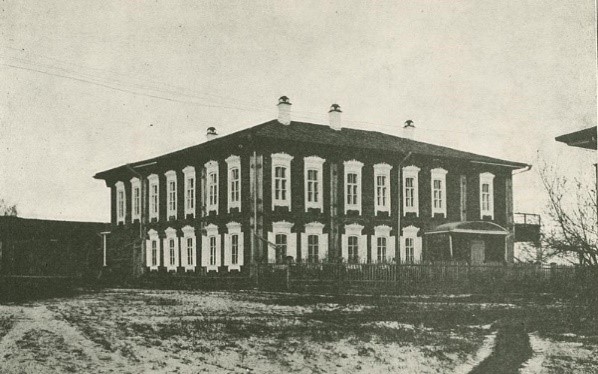
The collection had arrived in Washington in April 1907, after a long rail journey across Siberia and a voyage by sea. A decade later, organizing it was still a substantial task. According to the account published by Edward Kasinec, which draws on Derman’s letter of August 14, 1917, she found books scattered across floors, tables and chairs, covered with dust and awaiting systematic processing, and her correspondence describes the difficult physical conditions in which she was expected to work [1].
One detail stays in the memory: her request for an apron and a head covering. A professional librarian, entrusted with one of the most important Russian collections in America, found herself facing a problem far more elementary than bibliography: how to work among dusty books without ruining her clothes. The image is almost comic. The underlying issue is not.
The librarian who took her work seriously
Derman was no ordinary employee. She was a highly trained librarian whose career would later help shape library education in the Soviet Union, and her work on the Yudin Collection reflected a commitment to systematic cataloging and scholarly access. The disorder she met was not merely an inconvenience. A collection that is not properly organized is hard for researchers to use, and its condition is harder to monitor. Acquiring a great collection is only the beginning of an institution’s responsibility: the books must be examined, organized, described, stored and made accessible. Buying a collection is not the same thing as caring for it.
What the Library itself has written
Derman’s experience is not the only evidence. The Library’s own publications tell how the Yudin Collection fared after 1917.
- The collection was broken up. After the Slavic Section was abolished in 1943–44, the collection “was split up and dispersed to appropriate custodial divisions throughout the Library.” In doing so, the Library “went against Yudin’s wishes that the collection be kept together as a separate collection and housed in its own separate room” (Leich, 2008) [2].
- Thousands of volumes were sold off. In a cataloging drive that began in the mid-1960s, extra copies were designated “surplus duplicates,” deaccessioned, and offered to exchange partners or “for sale to antiquarian book dealers.” The Library’s former Russian area specialist writes: “Obviously, in retrospect, this never should have been done.” The number of volumes disposed of “is probably in the range of 3,500–4,500, but cannot be documented precisely” [2].
- The trail of individual books was not kept. When particular items were dispersed to other units, or a duplicate was sent to another library, that “is not recorded in the LC archives, bibliographic records, or internal memoranda” [2].
- The work is still not finished. In April 2022 the Library’s preservation blog, Guardians of Memory, stated: “The Library began processing Yudin’s books into the Library’s collections when they arrived in 1907, and that process continues today.” A rare book cataloger, with interns and volunteers, “has been working to account for the whereabouts of all the items in the Yudin Collection at the Library” [3].
The surplus channel still exists. In 2025 the Inspector General found that the Library’s Surplus Books Program, which also handles deaccessioned collection materials, is run by one person with broad discretion and that the Library has “no measure” of what enters it (Reading the Record No. 2).
A collection that arrived in 1907 is, by the Library’s own account, still being processed and still being located, 115 years later. That is not Derman’s testimony or ours. It is the Library’s.
More than a century later
The Library of Congress has changed enormously since 1917. Its conservation laboratories, cataloging systems, professional staff and preservation technology cannot reasonably be compared with those of the early twentieth century. The underlying questions remain. How promptly are newly acquired collections examined and processed? Are preservation concerns raised by qualified specialists documented? What happens when employees identify deficiencies in the management of historically significant materials? And how can the public judge independently whether the institution is meeting its responsibilities?
In 2022–2023 the medieval manuscript specialist Dr. Ilya Dines raised concerns about manuscript preservation and acquisition practices at the Library (Dines v. OCWR). Those concerns involved different collections, different circumstances and a different century, and the two experiences should not be read as proof that nothing changed in between. They illustrate a recurring principle: the preservation of cultural heritage depends not only on an institution’s prestige but on its willingness to listen to the specialists who work with the collections. The Inspector General still lists the collection services workflow and its arrearage as the Library’s first management challenge (Reading the Record No. 1).
The lesson of the apron
Henrietta Derman’s story is memorable because it is simple. A library acquired an extraordinary collection; ten years later a specialist still had to contend with dust, disorder and the practical difficulty of organizing it. The apron has become a vivid symbol of the distance between acquiring cultural treasures and giving them the care they need. A great library is measured not only by what it acquires but by how responsibly it preserves, documents and makes accessible what it already owns. These responsibilities deserve informed, independent public scrutiny.
Sources and further reading
- Edward Kasinec, “Yudin’s Books in America: A View from the 21st Century,” Slavic & East European Information Resources 9, no. 2 (2008): 115–126. https://doi.org/10.1080/15228880802178763
- Harold M. Leich, “‘So Ample a Collection, So Well Balanced’: The Yudin Collection at the Library of Congress,” Slavic & East European Information Resources 9, no. 2 (2008), reproduced in full by the Library of Congress: guides.loc.gov
- Leslie Long with Barbara Dash, “A Remarkable Collection of Books: The Yudin Collection at the Library of Congress,” Guardians of Memory (Library of Congress preservation blog), April 22, 2022: blogs.loc.gov
- Library of Congress, “Yudin Collection at the Library of Congress: A Resource Guide”: guides.loc.gov/yudin-collection
Library of Congress sources checked November 20, 2026.